
 Featured solutionHighway & Road ITS
Home / Solutions / Connected city / Smart Street Lighting
Connected city
Smart Street Lighting
Street lights that report their own condition and dim or brighten to an agreed schedule.
Conceptual workflow
- 1Schedule
- 2Operate
- 3Report
- 4Maintain
Illustration of the principle. Not a specific site or product.
Overview
What this solution delivers.
Conventional street lighting switches on at dusk and off at dawn, and a failed lamp is found when someone reports it. The lights have no way to say what state they are in.
A controlled lighting system gives each luminaire or group a controller and a network link. Operators set dimming schedules by road and by hour, see faults on a map, and measure energy use per feeder pillar instead of estimating it.
Typically for: municipalities, road authorities, district and estate operators, and lighting consultants.
At a glance
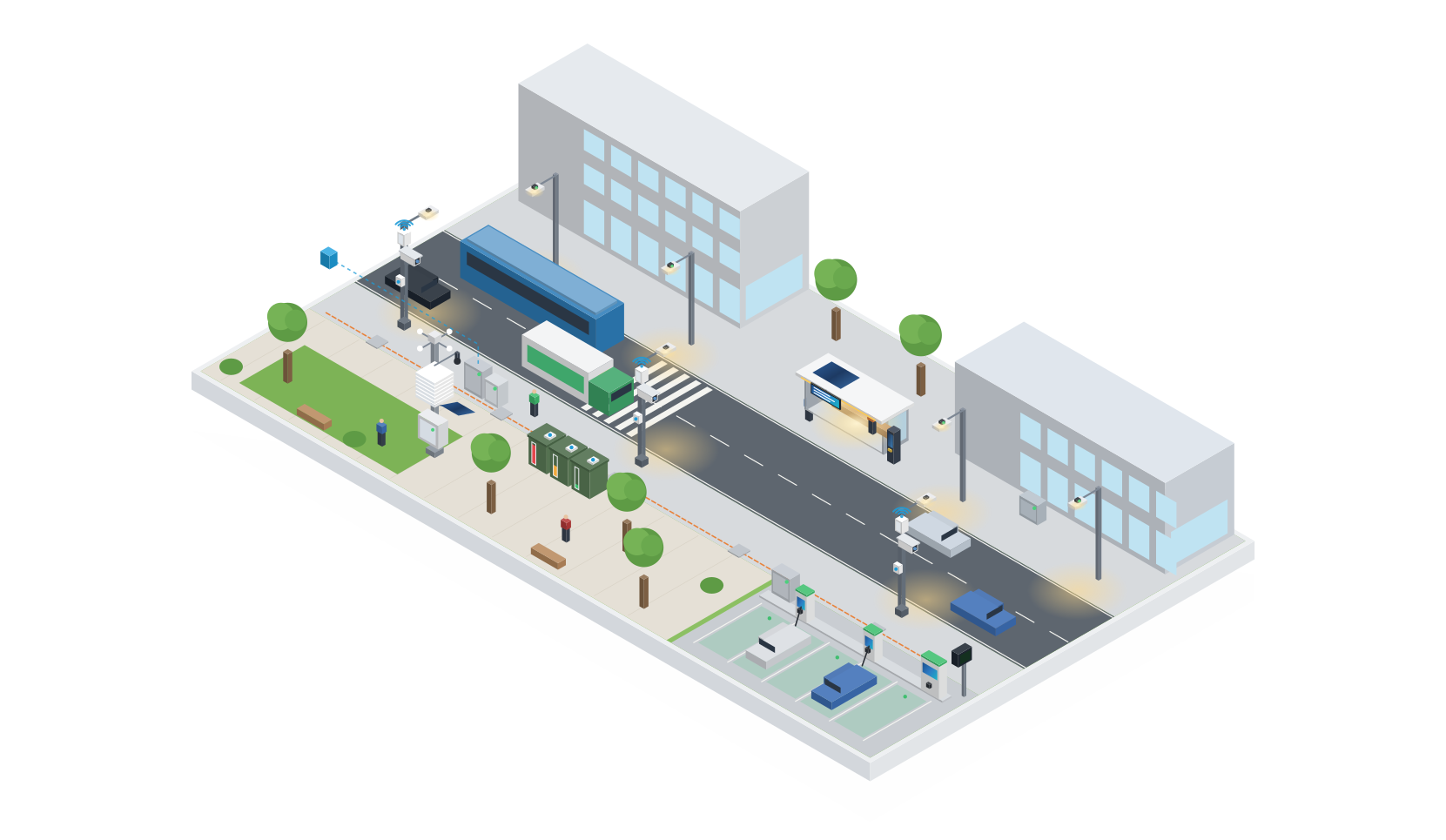
Every part of the system, in one picture.
Select a label to see what each device does. The 3D model below follows the system step by step.
Select a label
Smart Street Lighting
Every labelled part of the drawing is a device the system connects. Select one to see what it does.
Radio links carry schedules out and status back.
A smart pole light on the same control network.
Holds the schedule locally and meters the energy on each circuit.
Sensors on lighting columns connect through the same system.
Map, schedules, alarms and energy reports in one place.
Switches and dims each light and reports faults and energy use.
Illustration. Generic equipment, not a specific home, site or product.
How it works
Follow the system, step by step.
Select a numbered point or a step. Drag the model to look around.
Drag to rotate · pinch or use + and − to zoom
Illustrative model. Generic equipment, not a specific site.
Challenges
What typically goes wrong.
Faults reported by the public
Outages are found by night patrols or complaints, often days later.
One level all night
Roads are lit the same at the quietest hour as at the busiest.
Energy that is estimated
Consumption is calculated from lamp counts, not measured.
Records out of date
Nobody is sure which lamp type is on which column.
What we offer
What the scope can include.
Each project is scoped to its site. These are the parts we design, supply, integrate and maintain.
- Lighting asset survey and mapping
- Luminaire controllers for individual or group control
- Feeder pillar controllers and energy metering
- Lighting control network: radio mesh, cellular or power-line links
- Central lighting management software
- Dimming schedules and adaptive profiles
- Fault alarms and maintenance work orders
- Interfaces for sensors mounted on lighting columns
Technology categoriesControllers & cabinetsCommunication & networkingSoftware & platforms
Benefits
What changes for the people who run the site.
Faults known at once
The system reports an outage; nobody has to find it.
Light matched to need
Dimming profiles are designed to help lower energy use in quiet hours.
Measured consumption
Energy is metered by circuit, which supports budgeting and review.
A base for other services
Powered, networked columns can carry sensors and small devices.
Related solutions
Solutions that share sectors, settings or functions with this one.
 Urban mobility
Urban Traffic Management
Coordinated junctions and corridors, supervised from one operating picture.
Explore solution Connected cityAir Quality & Noise Monitoring
Continuous readings of air and sound across a city or site, shown on one map.
Explore solution Connected city
Smart City & IoT
Bring a district's assets onto one network and into one view.
Explore solutionAlso listed underSmart CitiesGovernment & Public SafetyUrban RoadsCommunication Networks
Questions
Common questions.
Can existing luminaires be controlled?
Many can, if they have a suitable driver and a controller socket or space for one. The survey shows which can be fitted and which need replacing.
How much energy will it save?
That depends on the existing lamps, the lighting classes and the dimming profile agreed with the authority. We estimate it at design stage from the surveyed assets and do not promise a figure in advance.
Discuss smart street lighting for your city.
The request opens with this solution already selected.