
 Featured solutionHighway & Road ITS
Home / Solutions / Connected city / Air Quality & Noise Monitoring
Connected city
Air Quality & Noise Monitoring
Continuous readings of air and sound across a city or site, shown on one map.
Conceptual workflow
- 1Measure
- 2Transmit
- 3Validate
- 4Inform
Illustration of the principle. Not a specific site or product.
Overview
What this solution delivers.
Air and noise conditions change street by street and hour by hour. A few reference stations describe a city in general; they cannot show what happens beside a busy junction or a construction site.
A monitoring network places compact stations where the question is. Each station measures dust, selected gases, sound level and weather, and sends readings to a platform that maps them, raises alerts and keeps the record.
Typically for: municipalities, environmental departments, road authorities, developers and contractors with monitoring obligations.
At a glance
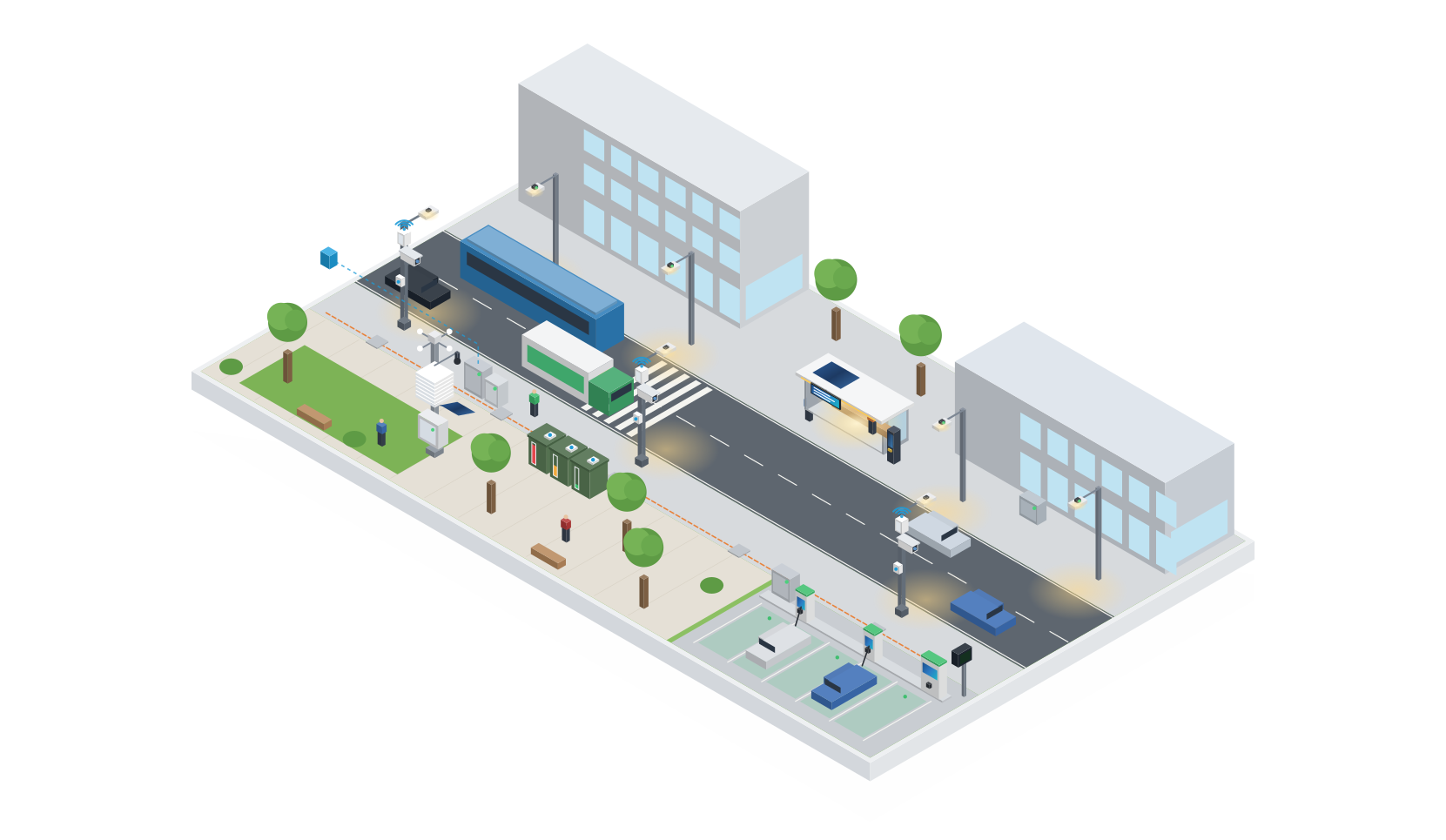
Every part of the system, in one picture.
Select a label to see what each device does. The 3D model below follows the system step by step.
Select a label
Air Quality & Noise Monitoring
Every labelled part of the drawing is a device the system connects. Select one to see what it does.
Stores readings and sends them over a cellular link.
Lets the station run where there is no mains supply.
Measure dust, fine particles and selected gases.
Measures environmental noise through the day and night.
Wind, temperature and humidity give the readings their context.
Validates readings, maps them and raises alerts.
Illustration. Generic equipment, not a specific home, site or product.
How it works
Follow the system, step by step.
Select a numbered point or a step. Drag the model to look around.
Drag to rotate · pinch or use + and − to zoom
Illustrative model. Generic equipment, not a specific site.
Challenges
What typically goes wrong.
Too few measuring points
Local problems fall between widely spaced stations.
Readings without context
A high value means little without wind, traffic or site activity beside it.
Sensor drift
Low-cost sensors lose accuracy unless they are checked and calibrated.
Data that arrives late
Manual sampling reports last week, not this hour.
What we offer
What the scope can include.
Each project is scoped to its site. These are the parts we design, supply, integrate and maintain.
- Monitoring plan and station siting
- Sensor stations for dust and fine particles
- Gas sensors such as nitrogen dioxide, ozone and carbon monoxide
- Sound level meters for environmental noise
- Weather sensors for wind, temperature and humidity
- Solar or mains power and data links
- Monitoring platform with map, thresholds and alerts
- Calibration, maintenance and reporting routines
Technology categoriesRoad Weather Systems (RWIS)Communication & networkingSoftware & platforms
Benefits
What changes for the people who run the site.
Local detail
Conditions are measured where people live, work and travel.
Timely alerts
A threshold breach is seen when it happens.
Cause and effect
Readings can be set beside traffic, weather and site activity.
A defensible record
Validated data supports reports to the authority.
Related solutions
Solutions that share sectors, settings or functions with this one.
 Urban mobility
Urban Traffic Management
Coordinated junctions and corridors, supervised from one operating picture.
Explore solution Connected citySmart Street Lighting
Street lights that report their own condition and dim or brighten to an agreed schedule.
Explore solution Connected city
Smart City & IoT
Bring a district's assets onto one network and into one view.
Explore solutionAlso listed underSmart CitiesGovernment & Public SafetyUrban RoadsConstruction SitesCommunication Networks
Questions
Common questions.
Are compact sensor stations as accurate as reference stations?
No. They are indicative instruments. They show patterns and changes well when calibrated and maintained, and they complement reference stations rather than replace them.
Which make of equipment do you use?
Equipment is selected against the project specification and confirmed at design stage.
Discuss air quality and noise monitoring for your city or site.
The request opens with this solution already selected.